

Weekly signal table
| Trend | Confidence | Commercial read |
|---|---|---|
| Retail media turns micro dramas into shoppable story inventory | High | P&G and Albertsons are linking scripted episodes, first-party shopper data, in-store screens and app commerce |
| India shifts from import market to local slate race | High | Sensor Tower data reported by Economic Times shows short-drama downloads up 403%, with local apps gaining share |
| Original vertical slates become a talent and production signal | Medium-high | Rocket Reels added eight originals after a 10-series launch, pointing to fast slate-building outside the US-China axis |
| AI dubbing moves from support tool to release strategy | High | Panjaya and Shortical's six-language deal makes localisation a core distribution lever for mobile-first storytelling |
| Monetisation models keep splitting by market | High | Deloitte, Sensor Tower and Peacock/ReelShort evidence show paid unlocks, free discovery, streamer tests and brand-funded series coexisting |
1) Retail media is turning micro dramas into shoppable story inventory
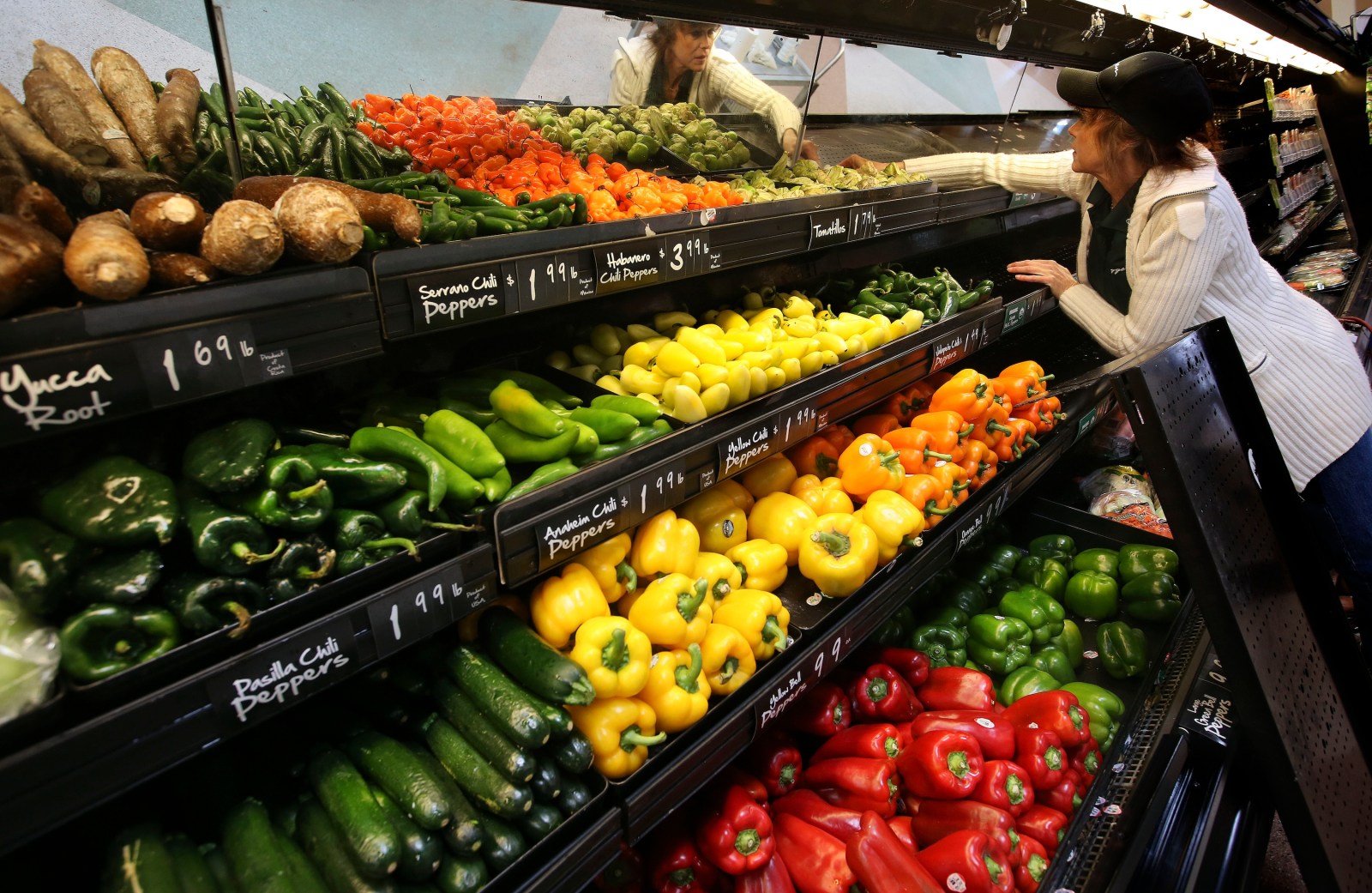
What changed this week: Procter & Gamble and Albertsons Media Collective announced Rico's Tacos, a scripted mobile-first microdrama built with Minivela and Brilla Media. Marketing Dive reported on June 17 that the one- to two-minute episodes will run across Albertsons' YouTube, social and in-store channels, with a shop-the-series feature in the Albertsons app and product appearances from P&G brands including Bounty, Head & Shoulders and Vick's.
Why it matters commercially: This is a sharper version of branded entertainment because distribution, context and measurement sit inside the retailer's media network. The story is not only competing for attention in a feed. It can be prompted by a store visit, reinforced on in-store screens, continued in the app, and measured against shopping behaviour. For brands, vertical micro dramas are becoming a way to test emotional context around real buying occasions.
Apply now: Build branded micro dramas around occasions, not product shots. Start with three shopper moments where attention naturally stalls: queue, deli counter, pharmacy, pickup, recipe planning or basket completion. Write each episode around a human problem, then place the product as a consequence of the scene. Use first-party retail data to choose the situation, but keep the script legible as entertainment.
What not to automate yet: Do not let the sales objective flatten the story. AI-assisted scripting can generate episode variants, but a branded vertical series still needs character tension, cultural specificity and a reason to watch the next instalment.
2) India is moving from micro-drama import market to local slate race
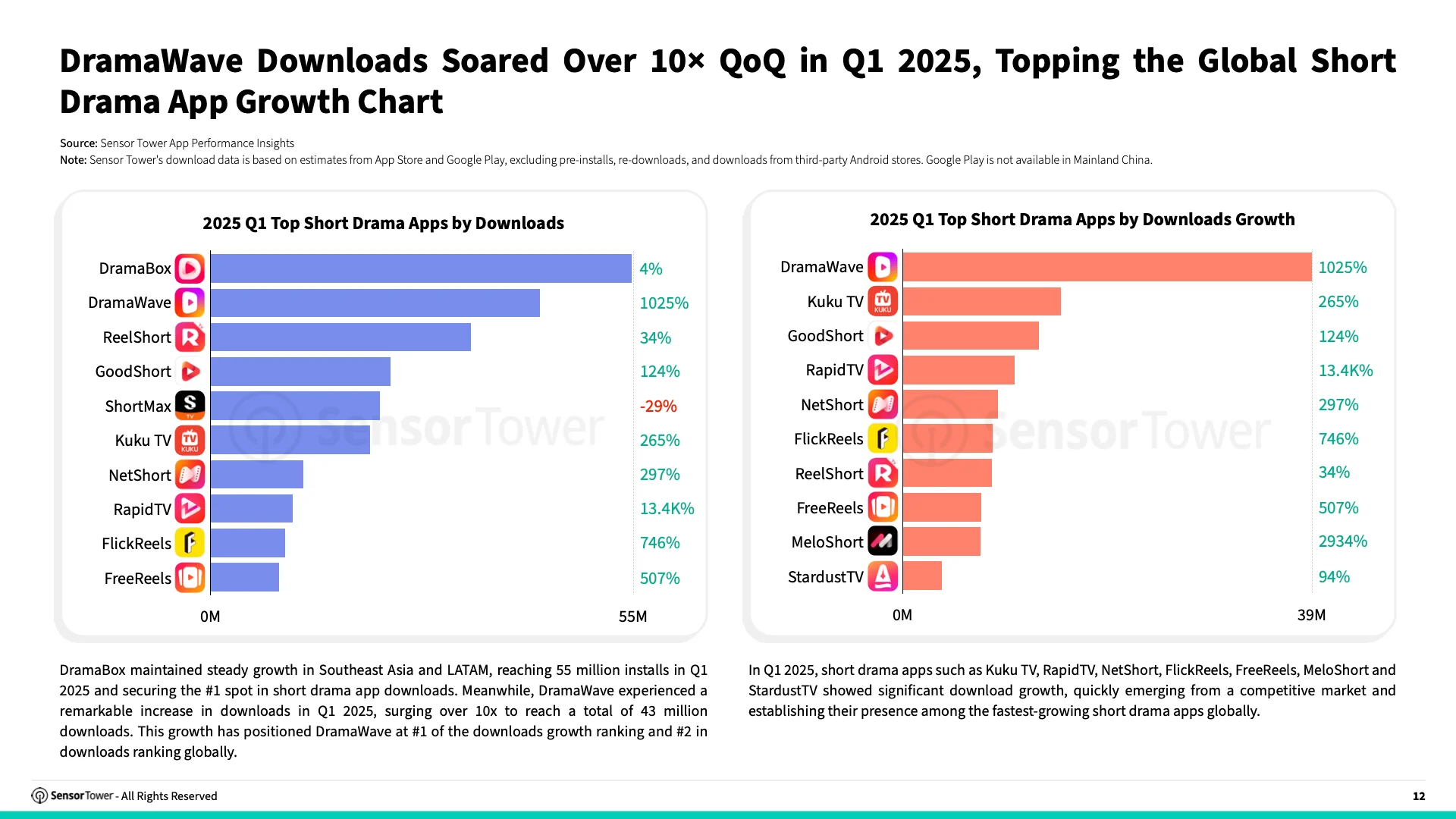
What changed this week: India is no longer only a dubbed-catalogue expansion market. The Economic Times reported Sensor Tower App Performance Insights showing India's mobile app revenue up 33% year over year to $300 million in Q1 2026, with short-drama app downloads surging 403%. It named FreeReels, Story TV and Kuku TV among the apps securing multiple top spots, and said FreeReels grew downloads 520% quarter over quarter, driven by aggressive digital advertising primarily on Meta platforms and strong appeal among users under 34.
Why it matters commercially: The market signal is two-sided. Imported vertical series can buy reach quickly through paid social and AI dubbing, but local platforms can win with language, casting, humour, status symbols and familiar social pressure. That means paid acquisition alone is not enough. The winning production stack will connect app-store movement, paid creative, local writers, AI pre-production and rapid audience testing.
Apply now: Treat India, Indonesia, Brazil and similar growth markets as story-development markets, not just localisation endpoints. Build title tests in the target language, test three trope territories with paid hooks, then greenlight local scripts around the highest-retention emotional promise. AI-assisted scripting should help map reveals and cliffhangers; local creative leads should decide what shame, aspiration, family conflict and romance actually mean in-market.
What not to automate yet: Do not assume a translated billionaire romance automatically becomes a local hit. Mobile-first storytelling travels when the emotional mechanism travels, not when every cultural detail is simply swapped by software.
3) Original vertical slates are becoming a production credibility signal
What changed this week: The Times of India reported on June 13 that Rocket Reels added eight new original micro-dramas after recently unveiling 10 original series in a single day. The new lineup includes titles such as Lady Bond 007, Honey Trap, Marriage Bureau, Khela Hobe, Tamatar Ki Chutney, Pathan The Killer, Ek Tha Kobra and Gents Tailor Ladies Not Allowed, with actors including Seema Pahwa, Zakir Hussain, Namit Das, Vikram Kochhar, Brijendra Kala and Dayanand Shetty attached across the slate.
Why it matters commercially: A visible original slate changes how studios, creators and agencies should read the category. The question is no longer only which app has the best paid unlock funnel. It is which platform can repeatedly commission, package and market recognisable vertical series with enough talent credibility to pull viewers beyond novelty. Slates also give brands more ways to integrate: sponsor a series, co-create a format, license characters, or use the production pipeline for campaign storytelling.
Apply now: Build micro-drama development like a slate, not a one-off experiment. Create three tiers: low-cost title and hook tests, medium-cost pilot arcs, and one hero series with recognisable talent or a distinct genre promise. Use AI pre-production for scheduling, locations, prop continuity and shot lists, then reserve human attention for casting, performance rhythm and episode-break tension.
What not to automate yet: Do not let generative video replace casting where familiarity is the selling point. In local vertical series, a trusted performer can carry cultural meaning that a synthetic face cannot.

4) AI dubbing is becoming a release strategy, not a post-production chore
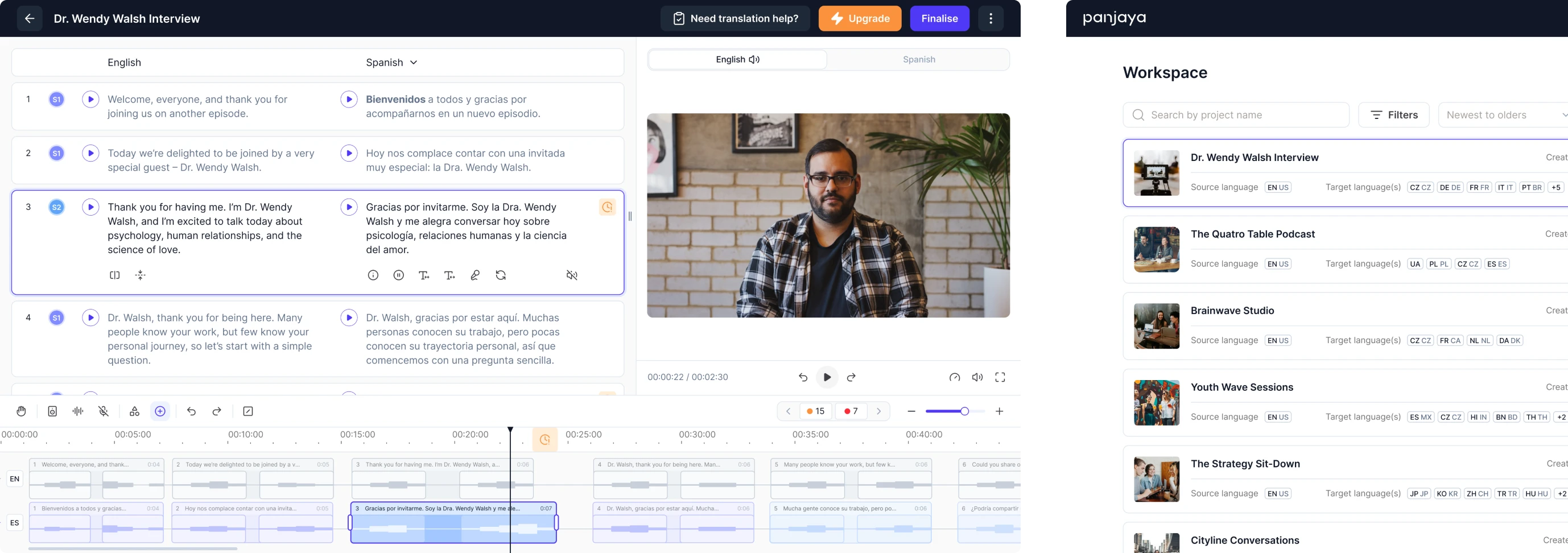
What changed this week: Variety reported that Panjaya.ai and Shortical have partnered on AI-powered localisation for mobile-first microdrama content, covering six languages and targeting more than one billion potential new viewers. Panjaya's own June announcement says Shortical content is being localised into Spanish, Portuguese, French and German, with Japanese and Russian next.
Why it matters commercially: Localisation is no longer a late-stage subtitle task. For vertical micro dramas, dubbing affects market selection, actor usage, performance rights, release cadence, paid acquisition creative and episode packaging. A series can now be tested in one language, adapted into several markets, and promoted with native-feeling voices quickly enough to influence the next production cycle.
Apply now: Build localisation into the bible. Track names, status markers, jokes, insults, family roles, product references, legal claims and music rights before the first shoot. Record clean dialogue, maintain consent and usage terms for AI dubbing, and create a human review pass for each target market. Use AI dubbing for speed, but test trailers and first episodes with local viewers before committing media spend.
What not to automate yet: Do not localise only the words. The difference between translation and adaptation is often the difference between a cheap catalogue dump and a vertical series that converts.
5) Monetisation models are splitting by market and distribution context
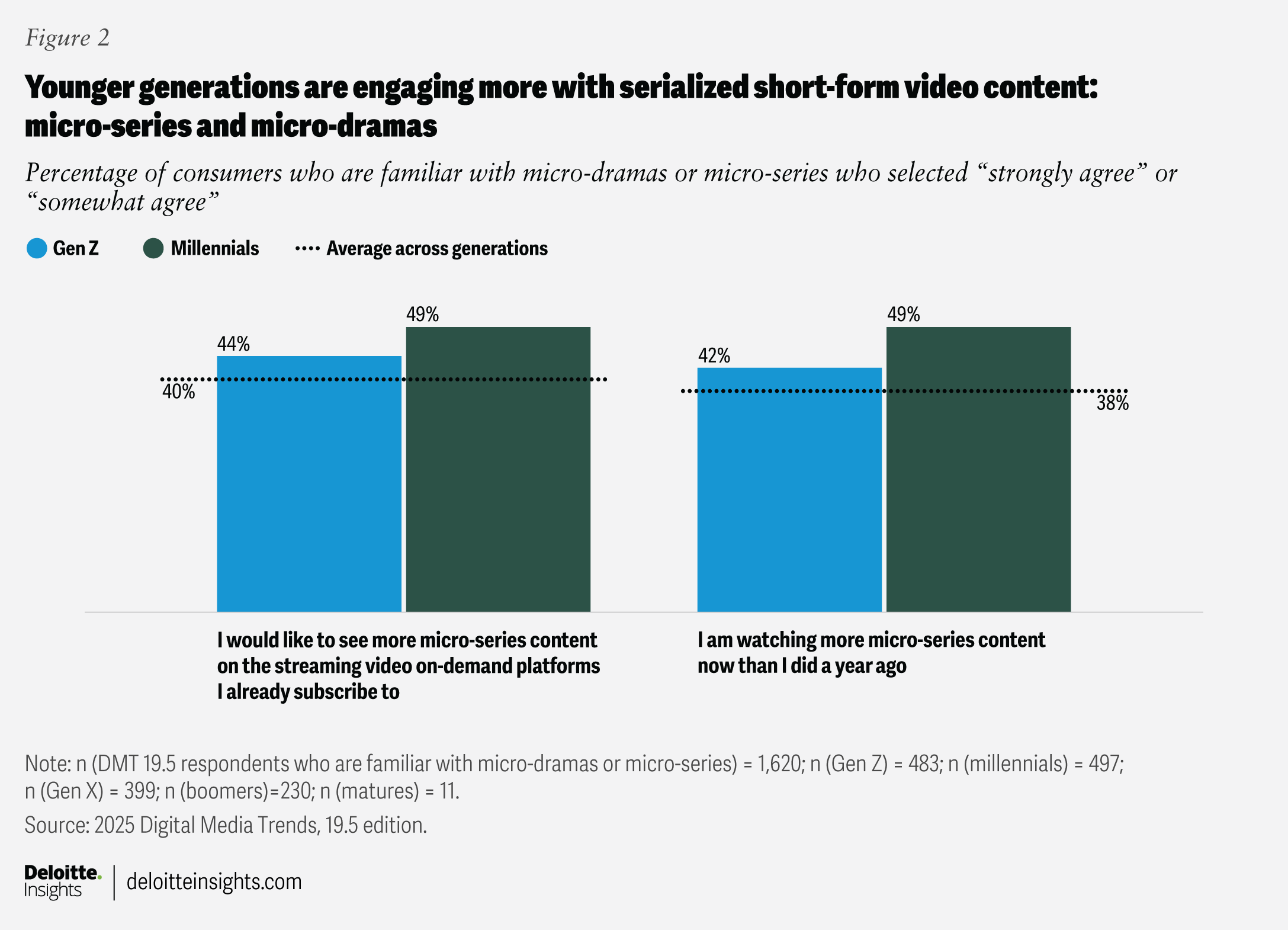
What changed this week: The category now has several valid commercial paths. Deloitte predicts in-app micro-series revenue will more than double from a forecast $3.8 billion in 2025 to $7.8 billion in 2026. Sensor Tower's overseas short-drama report showed ReelShort and DramaBox generating $130 million and $120 million in Q1 2025 in-app revenue, while rising apps such as NetShort and FlickReels grew quickly. Meanwhile, Peacock's May ReelShort licensing test shows streamers using vertical series as a mobile engagement layer, not only a standalone paid app.
Why it matters commercially: Studios and brands should not copy one monetisation model blindly. Romance/fantasy apps may optimise for coins, subscriptions and paid unlocks. Retail media micro dramas may optimise for app engagement and basket lift. Streamers may optimise for mobile session depth and younger-audience behaviour. Creator-led vertical series may optimise for social reach first, then sponsorship, licensing or app migration.
Apply now: Pick the monetisation thesis before writing the cliffhanger. A paid-unlock vertical series needs episode breaks that create unresolved emotional debt. A branded micro drama needs repeatable situations where product and story feel naturally connected. A streamer test needs navigation, retention and completion data. A social-first series needs hooks, comments and remixable moments that can travel without context.
What not to automate yet: Do not optimise every series against the same KPI. Audience testing is useful only when the metric matches the business model.
7-day micro drama action queue
- Studios: Build a three-market localisation plan before greenlight: source language, first dub market, second dub market, and human review owner.
- Brands: Identify one recurring customer occasion that can hold a five-episode branded micro drama without feeling like an ad reel.
- Agencies: Pair paid hook tests with script development so media results influence premise, title, thumbnail and episode-one structure.
- Creators: Use AI-assisted scripting for alternate cold opens and cliffhangers, then rewrite the winning version around voice and performance.
- Platforms: Separate metrics by monetisation model: unlock rate, completion, app session depth, basket action, qualified traffic or social lift.
Vertical Haus builds AI-assisted workflows for micro dramas, vertical series, short-form drama testing, localisation, dubbing, generative video support and mobile-first storytelling.
Sources
- Marketing Dive: P&G's latest branded microdrama is built on Albertsons retail media data, June 17, 2026
- Entrepreneur: Procter & Gamble is bringing a scripted show into grocery store aisles, June 18, 2026
- The Economic Times: India's mobile app revenue jumps 33%, led by AI and short-form content surge, May 2026
- The Times of India: Rocket Reels expands original micro-drama slate, June 13, 2026
- Variety: Panjaya.ai and Shortical partner on AI dubbing for microdramas, June 19, 2026
- Panjaya.ai: Shortical partnership announcement, June 2026
- Deloitte: Short-form video series prediction for 2026
- Sensor Tower: State of Short Drama Apps 2025 Report
- Business Insider: Peacock licensing ReelShort micro dramas, May 13, 2026